News
Health and Social Care Technologies
-
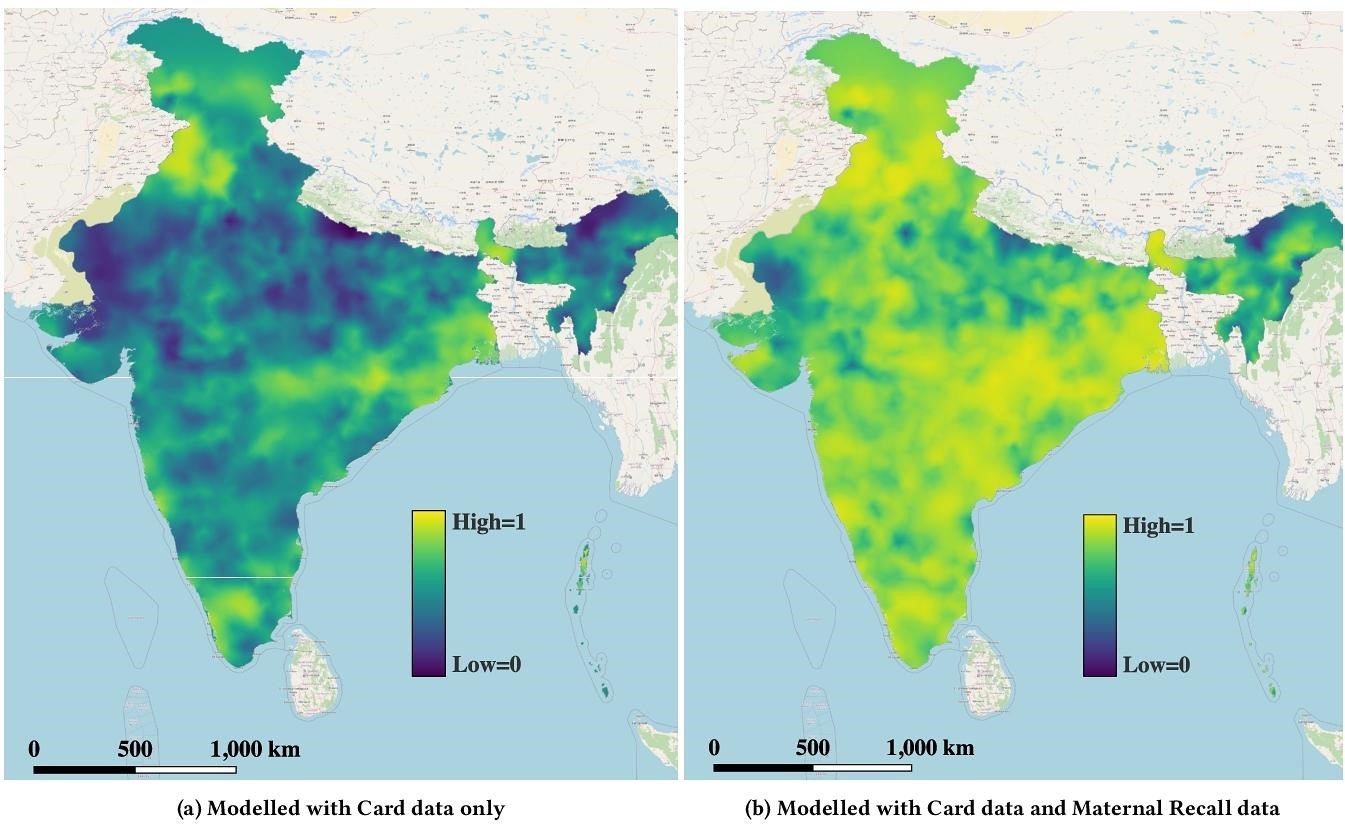
Immunisation uptake modelling and data collation: Vaccines are one of humankind's greatest forms of public health technology; but their public deployment raises significant behavioural and social issues which have only come to be properly recognised recently. The WHO has now identified vaccine hesitancy as a key public health risk. Better identifying pockets of under-vaccination and vaccine distrust, as well their behavioural and social drivers, has hence emerged as a central research direction in global health. We have been working on integrating both survey and administrative data sets to develop better localised estimation techniques for under-vaccination, drawing on geospatial machine learning methods to deal with missing/uneven data. Additionally, we seek to predict and explain vaccination outcomes as a function of both supply-side and demand-side factors, by drawing on and modelling their relations to a broader range of health and socioeconomic indicators. This involves the development of novel statistical computing methods that combine elements of multilevel, hierarchical, and latent-variable modelling techniques.
Faculty: Sumeet Agarwal (https://web.iitd.ac.in/~sumeet/), Aaditeshwar Seth (https://www.cse.iitd.ernet.in/~aseth/)
Collaborators: Mira Johri (University of Montreal), Alex de Figueiredo (London School of Hygiene and Tropical Medicine)
-
Assistive Technologies Laboratory (Assistech): The Lab conducts research and development in the area of assistive technology (AT) solutions to improve the lives of persons with disabilities. The research projects in the lab use embedded systems, AI/ML, robotic technology and product design. The goal is to improve the possibilities for education, independent and safe living and employment of persons with impairment in particular, the visually impaired, the elderly, children with disabilities, speech and hearing impairment etc. Active research areas in the lab include safe and accurate navigation for the visually impaired, AI-based intelligent robotic assistants for the elderly and those requiring nursing, deep learning based models for text-to-speech conversion, Generative AI for accessing educational material, information access and computing devices for children with disabilities for attending classes and taking exams, low-cost tactile braille displays, embedded AI devices to ensure correct use of assistive technology solutions, tools and technologies for tactile graphics for displaying graphical information for the visually challenged etc.
Website: https://assistech.iitd.ac.in/, https://www.ncaht.in/
Faculty: P. V. M. Rao (https://web.iitd.ac.in/~pvmrao/), Rohan Paul (https://www.cse.iitd.ac.in/~rohanpaul/),
Piyush Chanana