

Computer architecture
Co-developed with industry, built into products, and grown into deep expertise in energy-efficient computing
- Project
2000s–2010s
Faculty in embedded systems and computer architecture run projects with industry partners from the outset: memory hierarchies for multiprocessor SoCs (Semiconductor Research Corporation), smartphone energy efficiency (Samsung), and machine learning on the edge (Cadence). Each has eventual integration into products in view.
- Initiative
Groups and centres
MARG brings faculty, students and partners together around memory and embedded architecture. The R-Systems CoE for Applied AI for Sustainable Systems funds applied-AI projects, including hardware for AI on the chip.
- Ecosystem
Now
Energy-efficient computing has become a deep niche of expertise that draws the wider ecosystem to IIT Delhi, from chip companies and research consortia to students who go on to shape the industry. Faculty lead the field's journals and conferences.
6+
industry sponsors and collaborators of the architecture group, including Samsung, Cadence, Intel, NXP and SRC
The problem
AI workloads, phones, data centres and tiny edge devices must all deliver more performance within tight power and thermal budgets, and data movement through memory often costs more energy than the computation itself.
This cannot be solved in the lab alone. Solutions have to fit real chips and real products.
The security side of this work is Cybersecurity.
What we do
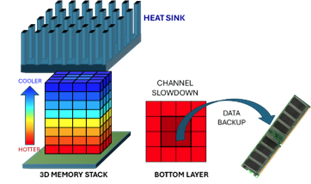
The Memory and embedded Architecture Research Group (MARG) works on energy-efficient embedded systems, shared-cache management, hardware for AI/ML, application-specific accelerators, emerging 3D and non-volatile memory, electronic design automation, and high-level and system-level synthesis. Related work spans thermal-aware systems, ML-driven industrial and PCB design, AR/VR design tools, neuromorphic hardware for very low-power navigation on drones, hardware for AI on the chip (an R-Systems CoE project), and quantum-circuit compilation.
How it grew
This story is not about a single product. It is about a way of working with industry. Projects begin with an industrial problem and a partner who can take the result into products. Colleagues then build lasting groups and centres around them.
Impact
- Industry-sponsored research: Samsung (smartphone energy efficiency), Cadence (edge ML algorithms and architectures), the Semiconductor Research Corporation (multiprocessor memory hierarchies), and research collaborations with Intel and NXP.
- Recognition: best-paper nominations at DATE and CODES+ISSS (2022), the VLSI Design/Embedded Systems Best PhD Thesis Award (2019), the FITT Award for an industry-relevant thesis, first prize at the Cadence Tensilica hackathon (VLSID 2019), the IESA Techno-mentor Award (2019), and Prime Minister's Research Fellowships for SIT scholars.
- Field leadership: SIT faculty serve as editor-in-chief of IEEE Embedded Systems Letters, associate editors of IEEE TCAD, and programme and general chairs of CASES and the VLSI Design conference.
- People: SIT-trained PhDs and M.Tech. graduates now work in the semiconductor industry, including at Intel.
What's next
New directions include energy-efficient on-chip AI accelerators, AI for chip and PCB design, neuromorphic computing for edge robotics, and quantum transpilation. Most are open to PhD, MS (Research) and pre-doctoral researchers.
 InitiativeOngoingSustainable and scalable computing
Energy-efficient computing and system-on-chip architecture
Next-generation memory systems, AI/ML hardware and 3D chip stacking, developed in close collaboration with industry for integration into products.
 ProjectOngoingSustainable and scalable computing
Energy-efficient on-chip AI accelerators
Refer to the owncloud document.
 ProjectOngoingSustainable and scalable computing
Quantum compute transpiler
Mapping classical Boolean functions through reversible logic synthesis to efficient circuits for 2-D nearest-neighbour qubit arrays.
- Pre-doc / Research Fellow
- PhD
- MS (Research)
Details
C/C++, compilers, back-end optimisation, physical CAD, LLVM
 ProjectOngoingSustainable and scalable computing
Very low-power SLAM on small drones
Real-time localisation and mapping in GPS-denied environments under a 5 W power cap, using spiking neural networks on neuromorphic hardware.
- Pre-doc / Research Fellow
- PhD
- MS (Research)
Details
Computer architecture basics, HDL, some ML

Faculty


Partners
- Samsungsmartphone energy-efficiency research
- Cadence Design Systemsedge ML algorithms and architectures
- IntelPhD research support
- NXP (Freescale)research collaboration
- Semiconductor Research Corporationmultiprocessor memory hierarchies
- R SystemsCentre of Excellence for Applied AI for Sustainable Systems
Links
Next story
